Women’s Cycles & Pole Fitness: How Hormones Affect Strength, Grip & Training Performance
Women’s Cycles & Pole Fitness: Why Some Training Sessions Feel Harder Than Others
Ever had a training session where everything clicked, followed by one a week later where you couldn’t hold your favourite spin, your grip felt terrible and your strength seemed to disappear?
You’re not imagining it.
For many women, the menstrual cycle can influence strength, energy, coordination, flexibility, recovery and even grip. Understanding these natural changes can help you work with your body instead of feeling frustrated by it.
Your Cycle Can Affect Your Training
Hormones fluctuate throughout the month, and those changes can influence how your body feels during pole training.
Some weeks you may feel incredibly strong and powerful.
Other weeks you might feel heavier, more fatigued, less coordinated or simply “off.”
That’s completely normal.
Learning to recognise these patterns allows you to adjust your expectations, training intensity and recovery without feeling like you’ve taken a step backwards.
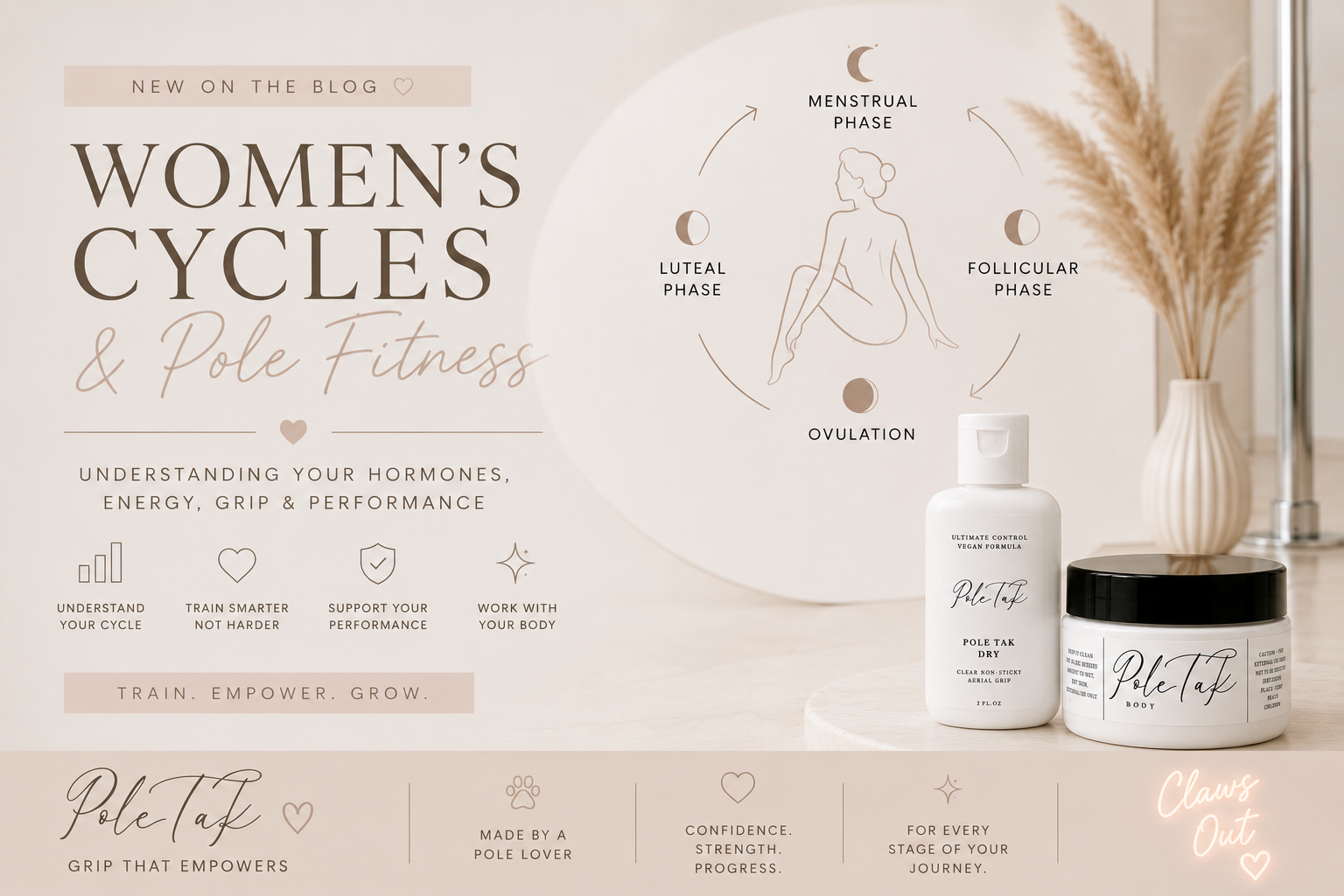
Menstrual Phase (Your Period)
Many women notice lower energy levels during the first few days of their cycle.
You may find:
Reduced stamina
Lower motivation
Increased fatigue
More sensitive grip due to sweaty hands or cooler skin
A need for longer warm-ups
Some women still perform brilliantly during this phase, while others prefer lighter sessions. Listen to your body.
Follicular Phase
As oestrogen begins to rise after your period, many women notice:
Increased energy
Improved recovery
Better coordination
Greater motivation
More confidence attempting new skills
This is often a great time to practise new tricks, combinations and strength-based movements.
Ovulation
Around ovulation, many women report feeling at their strongest.
You may notice:
Excellent grip
Higher confidence
Better power output
Improved athletic performance
This can be a fantastic time to challenge yourself with new goals.
However, because some research suggests joint laxity may increase around ovulation in some women, it’s still important to prioritise good technique and controlled movement.
Luteal Phase
After ovulation, progesterone becomes the dominant hormone.
Many women notice:
Earlier fatigue
Reduced grip
Feeling warmer
Increased sweating
Lower motivation
Slower recovery
This doesn’t mean you shouldn’t train.
It simply means some sessions might be better suited to refining technique, flowing through combinations or focusing on movement quality rather than chasing personal bests.
Why Does Grip Change?
Many pole dancers notice that their grip changes throughout the month.
Hormonal fluctuations can influence:
Skin moisture
Sweating
Body temperature
Confidence
Energy levels
If you’re slipping more than usual, it doesn’t necessarily mean you’ve become weaker.
Sometimes your body is simply responding to hormonal changes.
This is where PoleTak Dry Aerial Grip can help provide more consistent hand grip when conditions aren’t working in your favour.
If you’re struggling with skin-to-pole contact, PoleTak Body can also help improve body grip during sits, leg hangs and other contact points.
Work With Your Body, Not Against It
One of the biggest mindset shifts you can make is understanding that not every training session needs to be your best.
Progress isn’t measured by one class.
It’s built through months of showing up consistently, even when your body feels different.
Some sessions are for learning.
Some are for refining.
Some are simply for moving.
Every one of them counts.
Final Thoughts
Your cycle isn’t holding you back—it’s simply another part of understanding your body though your training.
By recognising how your energy, grip and confidence naturally fluctuate, you can approach training with more patience, less frustration and greater self-compassion.
Pole fitness is a long-term journey, and the strongest athletes aren’t the ones who feel amazing every session.
They’re the ones who keep showing up 🐾